It's a Girl but It Has a Penis & Family Guy
Due west hen Juliet Swire gave nascence to her third son in February 2014, doctors told her non to tell anyone he'd been built-in. She didn't announce Jack's arrival for weeks – non even to shut family and friends.
Jack was built-in with both male and female beefcake, with ovarian and testicular tissue, and genitals that could belong to either a male child or a girl. He has one of at least forty congenital variations, known collectively as disorders of sexual development (DSD), or intersex traits. It was months before Juliet and her hubby, Volition, were told Jack'southward specific diagnosis, of mixed gonadal dysgenesis. While they waited, all his parents knew was that Jack'southward sexual practice couldn't be determined at nativity, and that their doctors needed time to assign it.
"Ane of the cute parts of having a babe is beingness able to share the joy that this tiny, newborn person has entered the world," Juliet says. "We could have announced that our baby had been born with complications that mean we don't know if he's a boy or a girl. Simply the doctors took that abroad from us without any explanation." By encouraging them to continue Jack a undercover, the doctors made them feel there was something shameful well-nigh his condition, she says. "Information technology set the precedent for how other people were going to perceive information technology."
Jack's specific diagnosis is rare, but being born with a blend of female and male person characteristics is surprisingly mutual: worldwide, up to 1.7% of people accept intersex traits, roughly the same proportion of the population who have red pilus, according to the Office of the United nations High Commissioner for Human being Rights. The British clemency DSD Families estimates that effectually 130 babies born in this country each year need investigations before their sex is assigned. Other people may have problems with their hormones that aren't visible at birth.
Jack's parents knew he was different before he was born, when a routine scan couldn't determine if he was a boy or a daughter. Juliet was referred to a consultant at the local infirmary, followed by meetings with geneticists and neonatologists, claret tests and an amniocentesis. She was told her baby was genetically male person, but that this didn't necessarily brand him a boy. "It was very hard. I'd only causeless that XX is daughter and XY is male child," Juliet says. "Because people don't know there are variations, when they occur information technology'due south a freakish thing. But actually, he is only a normal kid."
Bouncing around the living room of their home in the West Midlands, Jack looks completely ordinary. With mousy, curly hair, a runny nose and a toothy smile, he clambers over Juliet and chucks a green football at me, oblivious to what his mother is telling me.
"My unabridged pregnancy, I'd worried that I wasn't going to exist able to love my baby because information technology wasn't a he and information technology wasn't a she," she recalls. Only when Jack was born, he was blue and floppy. "Although it was awful at the time, it was the best thing that could have happened: I would accept washed anything to have made certain he was breathing over again." Her optics fill with tears. "Quite rapidly, he was crying. The relief was unbelievable. He was a baby and he needed feeding. Making sure that he was cared for was my priority, not poking around in his nappy."
So someone from Bounty (a baby merchandising visitor whose sales reps, controversially, are allowed on maternity wards to collect mothers' details for marketing purposes and to sell photographs) paid her a visit when Jack was a day old; Will had just gone habitation to rest. She told Juliet she was there to take pictures of the babe: was it a boy or a girl? "We had no idea. Considering I was tired and emotional, I just said, 'Oh, he's a male child.' She and then got a blue blanket and a blue teddy and a label that said 'I'm a boy', and put it on him to have photographs. She never fifty-fifty asked permission to be there. When she left, information technology was the biggest meltdown I'd had yet."
The Swires say they withal feel let down past the team who were supposed to exist looking after them – non just the photographs, simply being advised by doctors non to denote Jack's birth, by the fact their midwife didn't read Juliet'south notes before delivering him, by the fact other people working in the hospital were non stopped from asking them the sex of their new babe. Most of all, they felt isolated by how fiddling medical professionals knew most disorders of sexual evolution. "The midwives have never heard of information technology. Our GPs take never heard of it. A&Due east doctors don't know, nurses don't know. It'southward rare – merely it's not that rare."
W hen it comes to wider public awareness of what information technology is like to be intersex, there is about none. While the transgender rights movement gathers momentum, and a growing number of people are choosing to identify as "not-binary" – neither male nor female – those who are born exterior the physical categories of male and female sexual activity have establish it more difficult to have their voices heard. They are atomised, connected just by condition-specific back up groups rather than united under a broader intersex umbrella. The terminology itself is fiercely contested: some find the "disorders of sexual development" label deeply offensive, as it implies a defect rather than a natural state of being. Others, often parents like Juliet, prefer DSD and reject the label intersex as "negative and sensationalising".
But a motion is start to emerge. Social media has presented fresh opportunities for older people to connect, seeing their difference every bit variations to exist embraced rather than defects to be corrected. A new generation is candidature then that children built-in like them aren't forced into biological categories: either socially, by being fabricated to identify as male or female on nascency certificates and other official paperwork; or on the operating table.
The sex on a baby'southward nascence certificate is mostly based on what their genitals look like, merely this is simply part of what makes a boy a boy and a girl a girl: there are likewise the ovaries or testes, the mix of hormones, the pattern of the chromosomes. Variations in any of these physical characteristics means bodies don't fall into the binary categories that make upwards conventional sex definitions. Sometimes these variations can lead to medical complications, such as infertility or hormone imbalances, merely nigh intersex babies are physically healthy. Not all have ambiguous genitalia, and some don't discover their status for years: girls with complete androgen insensitivity syndrome (CAIS) might non realise they are genetically male person until they reach their teens and their periods don't arrive.
"Normalising" surgery to make very immature children look more than typically male or female has been standard practice for decades. Malta became the first state to outlaw non-consensual medical interventions on intersex people (including those as well immature to give informed consent) in 2015. In January this twelvemonth, the Chilean government issued guidelines to doctors opposing corrective surgery, allowing them to refuse a parent and not face legal consequences. The parents of an adopted intersex boy are currently suing doctors and social services in South Carolina in the Us for removing his penis and testes at 16 months, even though it was not medically necessary – potentially opening the floodgates for hereafter litigation. Just in the UK, US and Commonwealth of australia, there is currently no national constabulary or guidance on corrective surgery: it is up to the individual infirmary or practitioner to determine.
For the Swires' doctors, there was no question as to whether or non Jack should have surgery. "Information technology was assumed that we would practise certain things the whole way along," Juliet says. "We weren't given an option." Their neonatologist was "very confident that operating on children to brand them more normal was the right thing to practice. His confidence gave us conviction."
After claret tests to ostend Jack'southward genetic makeup and appraise his hormones, and scans to look at his internal organs, it was decided that he should be assigned male. But the scans turned out to have given a false result: when he was nine months quondam, Jack was discovered to have a uterus and fallopian tubes, albeit ones that could never produce children. These were immediately removed, because doctors said they posed a high chance of malignancy and cancer; he has had two further operations that volition make him laissez passer more easily as male person. ("If you imagine labia – they stitched that together," Juliet explains. "They called it 'zipping it up'.") At the same time, they corrected Jack'south hypospadias, a condition that meant his urethra opened at the base of his penis, moving it further up so he could pee more than like a boy. He has further operations to come.
The pressure of making choices on Jack'south behalf has been tough on the Swires. "I'chiliad confident we have made the right decision," says Juliet. "I don't encounter him as strikingly different to his brothers. Merely there are flashes of doubt – generally effectually surgery days, when nosotros are making the decision to brand him a certain way. Based on all the information we've been given – simply still, nosotros are the ones making the decisions." She adds: "One of the doctors described it to us as your baby being born with an extra nose on their face. Would you exit it in that location, or would y'all set it?"
As if it were a deformity?
"Yes. Crevice lip – that'due south substantially a corrective thing; would y'all repair it? Yep, you lot would. It is a defect, information technology's not how information technology's meant to look."
The Swires' determination was fabricated without the support of psychologists or counsellors, or fifty-fifty family. Juliet gave up her chore in childcare to accept care of Jack full time, every bit fifty-fifty very close relatives accept establish his condition hard to take: she says she tin can't trust them to change his nappy without making him experience uncomfortable.
Juliet looks at Jack as he vaults across the sofa. "There is no pick to exist genderless in this society," she says. Would it take made a divergence if there were? "Information technology might take washed," she replies immediately. "If you could say you lot could be male, female or something else, and that was a normal thing to do in unusual circumstances, then it might have fabricated a difference. But you become with the majority, you get with what you think is right. While he is this young, I am the person making those decisions and I've got to be confident almost them. If he did identify equally female equally he gets older, I'd desire him to know I was confident that I was doing the right thing for him every stride of the fashion."
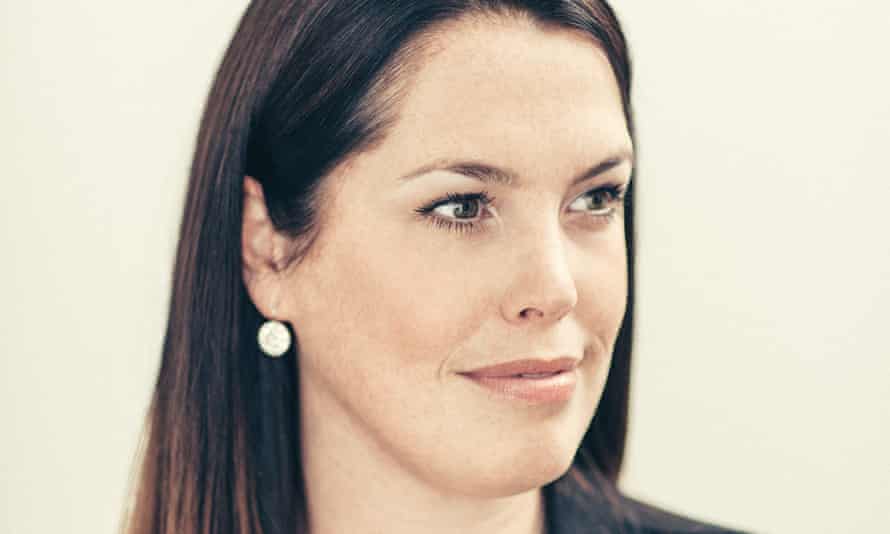
Dawn Vago has grown up with the consequences of having surgery to "correct" an intersex variation as a child. Now 35, she is genetically male but has always looked entirely female person. She has CAIS, complete androgen insensitivity syndrome: her torso has XY chromosomes but is unable to answer to male sex activity hormones, and so she developed female ballocks. Internally, she was born with testes instead of ovaries, and no uterus.
Warm and self-assured, Vago lives in Cheshire when she's not working as an entertainer on a prowl send. She is one of but a few British intersex people prepared to speak publicly on the issue. "My parents were told not to tell me, that I wouldn't understand and I wouldn't fit into society if I knew the shameful secret about myself," she says. "They wanted me to alive an open and honest life, and then they told me when I was five years old." Dawn'southward parents were told by doctors that she would get cancer if her testes weren't removed, so she had a total gonadectomy aged eight. "They said I would non survive puberty if I did not have the operation, and that wasn't truthful."
The communication regarding the cancer risk has since changed; it is at present thought to be minimal and to affect adults, not children – meaning the decision to remove the testes or ovaries tin can be left until people are old enough to make information technology themselves. Vago says the synthetic hormones she at present has to accept have left her with a higher hazard of developing breast cancer than she would have had of developing testicular cancer. "Because my trunk wasn't receiving the healthy hormones that information technology would have produced, and through mismanagement of my synthetic hormones, my body started to deteriorate." By the time she was in her mid-20s, Vago had adult osteoporosis and cleaved xi bones. She believes choices nigh medical intervention, be that surgery or hormones, should be left until the individual is old enough to make an informed decision.
Vago is living proof that intersex people can alive successful lives while being open up most being born outside traditional male and female categories. We're speaking a few days subsequently she has had a bid to adopt canonical. "Doctors told my parents that I would never find a human being who would love me, and I would never have my own family unit. I absolutely adore the fact that I am married and about to outset a family. It proves y'all command your ain life."
Similar the Swires, Vago's family unit learned to alive in a land of isolation. Doctors had told them their kid was totally unique: there were no other families to share experiences with, no support group to join. It wasn't until she was 22 that she found out she wasn't alone. "I was very angry at the time, because I'd spent the last 22 years not knowing where I fitted into gild – only to observe out at that place was a huge community out there that I could have continued with."
Dawn is at present co-manager of IntersexUK, a campaign grouping founded in 2011 to stop stigma around intersex variations, and to fight for equality and protection of intersex people. Top of its list of 33 demands is: "To put an finish to mutilating and 'normalising' practices such as genital surgeries, psychological and other medical treatments through legislative and other means." It is one of several British organisations now lobbying for cosmetic surgery to be outlawed in the UK. In March, IntersexUK and other campaigners met with members of the Scottish parliament to brand their case.
"Nosotros promote actual autonomy and fully informed consent," Vago explains. "The surgeries that are happening on intersex children are for the virtually part cosmetic. Most are almost making the child conform to society'southward ideology of what male and female person is. The child'due south trunk is the child'due south trunk to make up one's mind what they want to do with themselves." IntersexUK doesn't advise an age when information technology considers children erstwhile enough to give informed consent; British transgender children aren't offered the choice of gender reassignment surgery until they are at to the lowest degree 17.
"It's akin to female person genital mutilation, or as we term it, intersex genital mutilation, IGM," Vago says. "And it is happening in the Great britain right at present." On 9 June, IntersexUK was instrumental in getting the UN Commission on the Rights of the Child to reprimand the UK for allowing "medically unnecessary surgeries and other procedures on intersex children before they are able to provide their informed consent". The report institute that such surgery "tin crusade severe concrete and psychological suffering".
In 2013, the special rapporteur to the United Nations Human Rights Council'south report into torture and other roughshod, inhuman or degrading treatment called on member states to ban "forced genital-normalising" surgery. Concluding year, the Council of Europe's Commissioner for Human Rights demanded an "urgent" end to "unnecessary medical treatment and surgery of intersex individuals without their consent". In March, campaigners Joe Holliday and Ela Xora chained themselves to the Houses of Parliament and chosen for a Great britain government enquiry into corrective surgery.
"It is becoming increasingly probable that the government will take to motion on this, just as they moved on the gender recognition human action and the same sex spousal relationship act," says Dr Jay Hayes-Light, director of the UK Intersex Association, which lobbied MSPs alongside IntersexUK earlier this year. "This is long overdue."
Born intersex and given medical handling to assign him female person, a sex he didn't desire to be, Hayes-Light has lived as a human being since he was nineteen. Like Vago, he is campaigning for the correct not to choose a gender on nascence certificates, as the non-binary motility is. "You lot tin can't create a adult female with a scalpel and a tablet," he says, plain. "Medical practitioners view intersex every bit something that needs to be stock-still. We are regarded as deformed, somehow in deficit anatomically, and therefore the mode to fix information technology is to cobble u.s. together into what they deem to be an adequate format, instead of allowing united states to be in lodge."
Hayes-Light recognises that it is often the fearfulness of social rejection that motivates parents to choose surgery for their children; they only want them to be "normal", and not forced to be the vanguards of a political movement. "The opinion of other people should non be a catalyst, but it does matter," he says. "Parents need assistance, guidance and communication to bargain with it."
W hen Ruth Spencer gave birth two years ago in the Eastward Midlands, the midwife told her she had a boy. He was checked by the paediatrician; Ruth and her hubby were given the paperwork for his nascence certificate. But every bit they were about to exist discharged, the registrar came to their cubicle.
"She asked where the birth certificate letter was. I said it was in the car – nosotros were getting ready to leave – and she said, 'I'1000 sorry, yous're not going to exist able to leave, because nosotros don't know if your baby's a little boy or a daughter.'" With simply curtains to divide them from the residue of the ward, everyone around them could hear.
"It was our first kid, it was such an amazing experience – and so they just pulled the rug out from beneath united states. We told family unit we'd had a male child, nosotros had named him. Luke was born at 5.30am, and they didn't say annihilation to us until 4pm." It was another two days before Luke had an ultrasound; while the Spencers waited, each new shift of midwives asked them if they'd had a boy or a girl. "Such simple things could have made it so much easier," Ruth remembers.
Luke is now two and the family still don't accept a diagnosis. Genetically male, Luke was born with a small penis, undescended testicles and other variations that mean he has a DSD. "At some indicate in the not and then distant past, boys built-in with the genitalia our son had would accept been reassigned female person," says Ruth.
He has had ii operations: one was medically necessary to preserve his fertility; the other was performed to avert discomfort for him in the time to come, Ruth says. Choosing to go ahead with the procedures wasn't easy. "All my trust is in these doctors and even so there are such conflicting opinions on what should be done. We were of a mind to leave all treatment for equally long as possible, then that nosotros could involve him. No ane ever asked us, are you lot OK with this? It was simply, this is what we're going to do. Abnormality, disorder, problem – these are all the words that are thrown at y'all. It makes it out to be something wrong. It might non exist the standard, but it'due south still nature." She sighs. "It's such a huge decision to make."
In theory, parents like Ruth and Juliet should be assigned specialist psychological back up to help them make these decisions, only provision around the country is patchy and underfunded. Fifty-fifty where experienced psychologists are available, they are stretched.
Dr Julie Alderson, a clinical psychologist at University Hospitals Bristol NHS Foundation Trust, has been working with parents of children with DSD since the tardily 1990s. Nearly every family she meets has felt aback or embarrassed after their treatment on the motherhood ward, she tells me. While tests and surgical techniques have changed over the course of her career, she still hears parents describing "the same problems, the same worries, the same purgatory of fourth dimension" equally they did twenty years ago.
In Bristol, Alderson works aslope an interdisciplinary team of surgeons, geneticists and endocrinologists. Her role is to offering families space to think. "All of the very well-significant, passionate and caring healthcare professionals involved take got stiff views nearly what's the right thing, and they present options for all kinds of treatment in a manner that is leading, in the nicest possible fashion. People don't experience that they are making a decision: it's very easy to accept what'south offered and what feels like information technology's being recommended. I'm saying to the families, what are yous actually hoping for for your child? And how much will surgery evangelize that?" Parents may hope surgery will allow their children to be more comfortable in their bodies, simply a child raised to take a positive identity almost being different might be more than secure than i who has scars and needs regular hospital checkups, she argues.
The surgical team at Bristol Children's Hospital who work with Alderson know that an emerging human rights entrada is focusing on their work. "We're doing it less and less," says consultant paediatric urologist Guy Nicholls. "We have go more mindful that, whatever surgery yous do, yous are preserving fertility for the future and not doing something early for a corrective reason which may then jeopardise function in the hereafter. Whatsoever surgery for this sort of problem is a petty bit of a compromise – you try and include the parents and manage their expectations, making them realise we can't attain normality, no matter how much we want to or how difficult we try."
Nicholls' words may be couched in the language of "abnormalities" and "problems", but he says that'south how most parents view disorders of sexual development. "Surgeons are under constant pressure from parents to 'sort information technology out'. They want their kid to be normal. They want the trouble to go away. That's admittedly understandable. But the more severe the abnormality y'all have, the more hard it is to accomplish satisfactory results."
If surgery is successful enough for people to pass as their called sex without whatsoever complications, they don't want to broadcast that they've had information technology, Nicholls points out. "We don't tend to hear from the people who practice very well. Y'all hear a lot from the people who have had a lot of problems." These are bug largely with sexual part, and a need for further surgery as a kid grows older. "They relate to procedures that were washed some time ago, which are probably slightly different from what many of us are doing now. We like to think we are causing less scarring, fewer problems for the future – just nosotros won't know for xx years."
Mark Woodward, a paediatric surgeon and urologist who works alongside Nicholls, agrees. "A small-scale group of people who have had surgery and are understandably unhappy will detract from a genuine flick of a whole load of people not being unhappy. It's tricky to write off surgery on the basis of that."
Surgery in infancy is more than straightforward than subsequently in life, Woodward argues: tissues are easier to operate on and heal better, and the distances to bridge are smaller. Performing an operation before a baby can remember the trauma spares them the distress of going through it as a teenager. Plus, no 1 has expertise in operating on immature people quondam enough to give informed consent.
"If everyone is besides worried about doing the wrong affair by these children at present, and we say, 'Let'due south leave it until they're fifteen,' who's going to do the surgery? Information technology isn't going to be a paediatric urologist. It'south non similar there is a generation of surgeons out there who volition have had any experience of this very niche surgery. I just worry that people volition become too scared to do anything for fear of doing the incorrect thing, so be putting off a problem that will exist a real surgical challenge. Surgeons are getting less experienced, if anything." While the Swires' doctors did not hesitate to recommend surgery, others are increasingly reluctant.
At that place is little data on the wellbeing of intersex children who don't take surgery, with non enough studies and too few cases for meaningful conclusions to be drawn. Deciding not to operate on a kid comes with some consequences, just every bit choosing surgery does: raising a child with ambiguous anatomy in a world where a binary understanding of sex withal rules is not like shooting fish in a barrel.
At the moment, both options are available to British parents: to refuse or opt for surgery. And while a ban on "normalising" surgery is not imminent, the intersex rights movement is already having an impact on medical attitudes and surgical decisions: a growing number of British parents are beginning to choose for their children not to accept any surgery.
Tanya Dart's daughter Clara, at present 5, has CAIS, the same condition as Dawn Vago. Doctors in the hospital where Tanya gave nascence noticed something looked unlike as soon as she was built-in. "I'd never had a baby before, I merely thought that's what newborn babies looked like," Tanya smiles. She is sitting in the living room of her London home, speaking to me over Skype in the brief window while she has a break from Clara and her seven-month-old brother. The doctors told Tanya she had a babe girl, only wrote in her notes that Clara was "ambiguous".
Like Ruth, Tanya was told about her girl's condition behind a curtain on the motherhood ward. "Information technology was about 9pm and my hubby had gone home. The registrar put his hands on his hips and started whispering, 'You know, these could exist testes. I hope you understand – this could be a boy.'" She shakes her head in atheism. "It was like he was sharing a piece of gossip. I kept looking at my baby thinking, this tin can't be. I hadn't heard of intersex or DSD. If I'd heard annihilation about it, I'd have been more prepared."
The Darts were referred to Great Ormond Street Hospital, where they met a psychologist and an endocrinologist. "They explained it so well. They fabricated everything clear and they were compassionate, and then I didn't fifty-fifty remember about surgery. The option was there, just the way they were explaining to us, information technology was quite clear that we could leave it. Information technology made the choice easy."
They know slap-up challenges lie ahead for Clara. They oasis't decided how and when they are going to tell her. "We are following advice from the hospital that it has to exist a very gradual process, starting from when nosotros think is all-time," Tanya says. They know that Clara will never exist able to get meaning, and take explained to her that some women tin't have babies of their own and can choose to adopt if they want to. Clara thinks that sounds like a very kind thing to practice.
But their greatest worry is about how Clara might be perceived in a world that is unforgiving of difference. "Why is there stigma attached? In terms of beingness able to talk to others, and not be petrified nigh what people volition think of us. I feel that everyone would have their children away from my kid and say, 'Don't play with her' if they knew." Tanya pauses. "I want as many people equally possible to know about these atmospheric condition. I desire it to be the kind of thing that people tin talk about. I promise there will be a mean solar day in my girl's lifetime where everyone knows well-nigh intersex, and it's no big deal."
Some names have been changed.
- This article was amended on Saturday 2 July. In the standfirst, the word 'gender' was replaced with the word 'sex'.
Source: https://www.theguardian.com/world/2016/jul/02/male-and-female-what-is-it-like-to-be-intersex
0 Response to "It's a Girl but It Has a Penis & Family Guy"
Post a Comment